Get found in search and in AI answers.

We fix the technical and content problems that stop search engines—and AI assistants such as ChatGPT, Perplexity, Gemini, and Google AI Overviews—from finding, understanding, and citing your site.

Clear plan. Steady work. Honest measurement. No ranking guarantees.

We don’t promise rankings or a place inside any AI answer. Search and AI systems change; no provider controls their results.

Two ways people find you

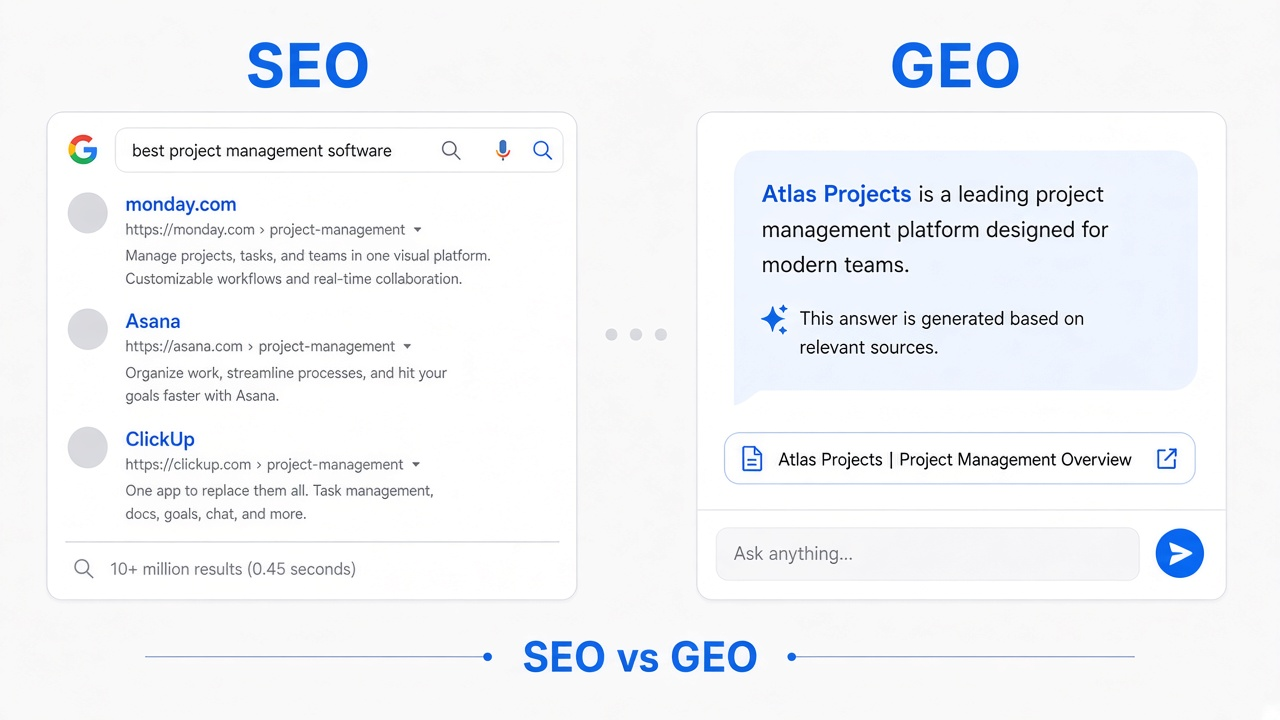
Classic search lists links. Generative engines often answer inside the chat—and may cite a source.

What is generative engine optimisation (GEO)?

GEO helps your brand get mentioned and cited in answers from assistants such as ChatGPT, Perplexity, Gemini, Google AI Overviews / AI Mode, and Microsoft Copilot — with descriptions that are factually right. SEO helps you appear in a list of results; GEO helps you appear inside the answer.

Score ideas we track: Mentions · Citations · Accuracy · Share of voice vs named competitors.

Diagram comparing SEO as a list of search result links with GEO as a concise generative AI answer that cites a source.
SEOGEO
Full nameSearch engine optimisationGenerative engine optimisation
GoalHelp search engines crawl, index, and list your pages for the right queriesHelp AI assistants mention and cite you accurately when people ask category, comparison, or how-to questions
What “winning” looks likeA clear listing people can clickA mention and/or a citation (link or named source) inside the answer
Typical workCrawlability, speed, titles, internal links, useful pagesEntity clarity (/about, pricing, FAQ), answer-shaped content, structured data that matches visible text, real third-party mentions
OverlapIndexable, trustworthy pages help both. GEO is not a replacement for SEO—it builds on it.

SEO helps you appear in a list of links. GEO helps you appear inside the answer—when the model has a clear, citable reason to trust you.

Why SEO alone is no longer enough

More discovery happens in AI answers. If those answers never mention you—or mention the wrong company with a similar name—you lose the conversation before the click.

People still use Google. They also ask ChatGPT, Perplexity, Gemini, Copilot, and Google’s AI surfaces the same buying and research questions. Those systems pull from the open web, brand entity signals, and third-party sources—not only from your ads account.

Across the market, tools and agencies now sell “AI visibility” monitoring (prompt tracking, citation dashboards) or full execution (content agents, outreach). The useful pattern is the same: fixed prompt set → multi-engine measurement → owned-site fixes + earned mentions → re-measure. What does not have strong evidence: treating llms.txt as a silver bullet, buying fake mentions, or promising a #1 ChatGPT slot.

What we see in practice

(Generalised observations — no client metrics on this page.)

  • Brand-name queries often surface something. Category, problem, local, and long-tail queries often surface competitors or lookalike names instead.
  • Same-name products and apps get mixed up unless /about, pricing, and manufacturer facts are clear and repeated on pages machines can read.
  • Monitoring SaaS can show the gap; execution—structure, facts, real community answers, honest outreach—is what moves the needle. That is where we spend the engagement.

We are a done-with-you / done-for-you service, not a monitoring SaaS subscription. We use free official reports (Search Console, Bing Webmaster AI Performance where available), server or CDN logs, and a frozen prompt set. Budget goes into content, technical fixes, and real participation—not into paid “guarantee” schemes.

What we do

Five workstreams, one playbook. Mapped to our internal GEO delivery process.

Diagnose

Discovery & baseline

  • Stakeholder interview: product, audience, competitors, constraints.
  • Freeze a prompt set (typically ~25–40 prompts): branded, category, comparison, task/how-to, local or timely.
  • Run the set across agreed engines, with repeat runs noted for noise.
  • Score mention rate, citation rate, share of voice, description accuracy, and a source-gap list.
  • Deliverable: one-page baseline conclusions + spreadsheet detail + 90-day roadmap.

Technical foundation

  • Indexability: crawlable pages, clean canonicals, sitemap, broken-link cleanup.
  • Robots / bot access: allow retrieval-class AI crawlers the client agrees to; document training-bot policy in writing.
  • CDN/WAF: check bot protection is not blocking those crawlers.
  • JSON-LD that matches visible content: Organization (with sameAs), WebSite, Article/FAQ where real.
  • Entity pages: /about, FAQ, pricing, methodology—with a short answer block near the top.
  • Optional: IndexNow + Bing Webmaster; keep llms.txt accurate if present—not sold as a KPI driver.

Content

  • Answer-shaped pages: facts first, question-style headings, tables, author/update date, citations.
  • Comparison and alternatives pages that are honest (date-stamped; disclose if you appear on your own list).
  • Q&A / how-to pages aimed at non-branded prompts in the set.
  • Human review of any AI-assisted drafts; no scaled doorway or spun content.

Off-site (earned)

  • Real answers on communities the client can disclose—identity disclosed; no sockpuppets, no vote buying.
  • Outreach to listicle/review authors from the source-gap list: facts, screenshots, trial access—no paid placement as part of our package.
  • Directory / review profiles where they fit the product, inviting only genuine users.

Measure & iterate

  • Re-run the frozen prompt set on a fixed cadence (e.g. every two weeks).
  • Cross-check with Bing AI Performance and Google generative reports when available; AI-bot fetch evidence from logs after new pages ship.
  • Fortnightly one-pager: KPI trends, what shipped, evidence screenshots, next plan—sample size and noise called out.

A practical 90-day rhythm

Timelines are planning aids, not guarantees. Non-branded AI mentions often take longer than a single sprint.

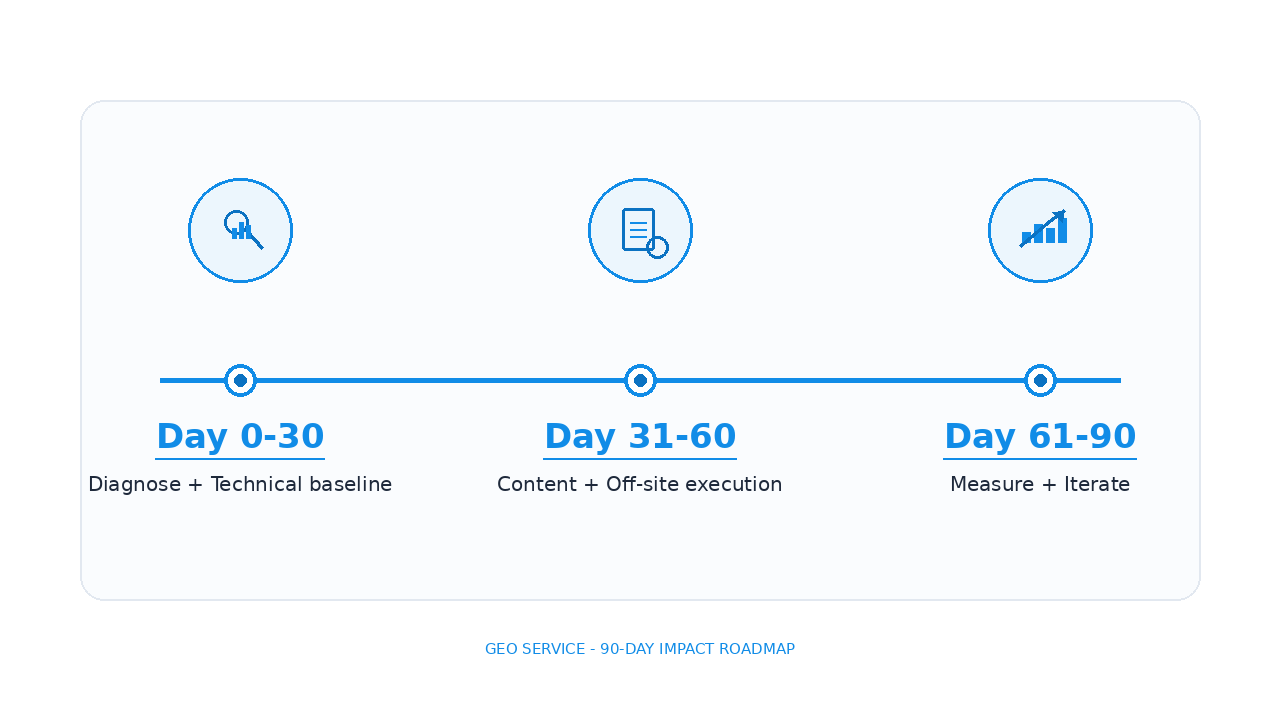
Ninety-day planning timeline for SEO and GEO work: foundation and baseline, gap closing and earned mentions, then measure and iterate.
WindowFocusTypical outputs
Days 1–30Foundation + baselineBaseline report; robots / crawler access; JSON-LD templates; entity pages; IndexNow where relevant; first answer-shaped pages; start honest community contribution; log dashboard
Days 31–60Close gaps + earnedComparison / alternatives pages; outreach from the source-gap list; optional small original-data note; mid-cycle retest vs baseline
Days 61–90Prove & plan nextMore pages as agreed; directories/profiles completed; 90-day retest; written case notes for the client; next-quarter roadmap

We optimise for process metrics you can re-run yourself (mentions, citations, accuracy, crawl evidence)—not for a promised rank.

How we prove progress

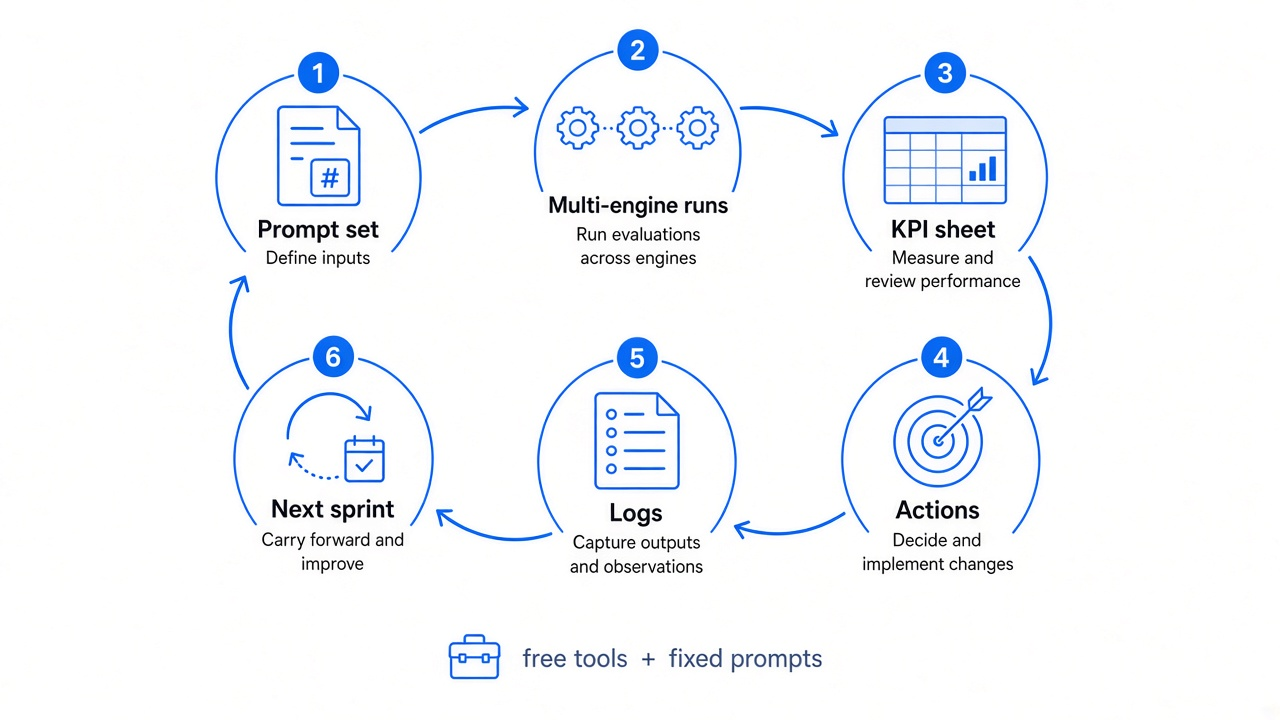
We re-use the same prompt set so comparisons mean something — not a screenshot of one lucky chat.

A circular six-step measurement loop for GEO work: prompt set, multi-engine runs, KPI sheet, actions, logs, and next sprint, using free tools and fixed prompts.
  • KPIs Mention rate · Citation rate · Share of voice · Average position when mentioned · Accuracy · AI crawler fetches of new URLs · Referrals from AI hosts (when present)
  • Tools we lean on (free / first-party) Fixed prompt sheet · Bing Webmaster Tools AI Performance · Google Search Console · Server/CDN logs by user-agent · Your analytics for AI referrals

AI answers are noisy. We sample more than once, note limits in reports, and never sell a single anecdote as a trend.

What you receive

  1. GEO / SEO baseline report + frozen prompt workbook
  2. Technical audit checklist and fix log (robots, schema validation screenshots, crawl notes)
  3. Entity and content pages (volume per engagement scope)
  4. Source-gap list + outreach log
  5. Community contribution log (URLs + disclosure method)
  6. Fortnightly progress notes + 90-day summary
  7. Handover notes so an internal team can continue measurement

Packages and scope are quote on request. We do not publish rates on this page.

Audit (one-off)

  • Frozen prompt set across major answer engines (repeat runs to reduce noise)
  • Technical GEO/SEO audit (crawl, robots, structured data, entity gaps)
  • Source-gap list
  • 90-day roadmap
  • Credit toward a follow-on monthly engagement if you continue with us

Foundation (monthly)

Typically 3+ months

  • Priority technical fixes
  • Core entity / fact pages
  • About four answer-ready pages per month (scoped)
  • Fortnightly one-page progress note with evidence
  • Log / official-report proof that new pages were fetched

Growth (monthly)

Typically 3+ months

  • Everything in Foundation
  • Higher content cadence (about eight pages / month, scoped)
  • Steady, disclosed community participation
  • Monthly outreach batch to relevant authors / sites
  • Quarterly original data or methodology note when it fits

Enterprise (custom)

  • Multi-brand, multi-language, or multi-region prompt sets
  • Extended stakeholder reporting
  • PR support only where there is a real story
  • Scoped after discovery

Excluded on purpose: paid listicle placements, fake reviews, traffic bots, “guaranteed #1 in ChatGPT.”

What we don’t do

Hard boundaries. If a vendor promises the opposite, ask how they would prove it.

We don’tWhy
Promise rankings, “#1 in ChatGPT,” or guaranteed citationsNobody controls model outputs; Google also warns against rank guarantees
Buy links, fake traffic, or non-genuine brand mentionsAgainst platform rules and Australian consumer law risk; weak long-term signal
Buy review or listicle placement as part of the engagementPaid placement needs clear disclosure; we keep packages free of that conflict
Incentivise fake reviewsPlatform and ACL risk
Ship scaled AI content without human fact-checkTreated as spam by search systems; harms trust
Sell llms.txt or a magic schema snippet as the whole strategyWeak or negative evidence as a standalone tactic
Hide who we are in communitiesDisclosure is required when we mention the client’s product

Method note: on our own products we use the same playbook—freeze prompts, score mention/citation/accuracy, fix entity pages and structure first. Example of method only: clarifying manufacturer and /about facts so AI answers stop confusing similarly named apps. No traffic or ranking claims on this page.

FAQ

How long until we see results?

It depends on your starting point, niche competition, and how fast pages can ship. Some technical fixes show up in crawl logs within days; non-branded AI mentions often need 60–90+ days of steady work. We do not promise a date when AI will recommend you.

Do you guarantee we’ll appear in ChatGPT / Perplexity / Google AI Overviews?

No. We improve the inputs those systems can use and measure trends on a frozen prompt set. Appearance is never guaranteed.

Is this instead of SEO?

No. Indexable, well-structured pages are the foundation. GEO adds answer-shaped content, entity clarity, and earned citations on top.

What access do you need?

Typically: ability to change or request changes on the site (CMS or repo); Google Search Console; Bing Webmaster Tools when available; analytics (e.g. GA4) read access; and CDN or server logs enough to see bot user-agents and status codes. We do not need payment-card data or end-user passwords. Invites and least-privilege roles only.

How is this different from an SEO-only agency or an AI-visibility SaaS tool?

SEO-only work often stops at classic rankings and may skip AI citation measurement. SaaS tools are strong at monitoring prompts and citations; they usually leave execution to you. We combine measurement with technical, content, and earned-media execution—without requiring a paid tracking subscription as the product.

Will you run paid ads or buy directory spots?

Not as part of this service narrative. Zero paid placement in the default engagement. If you later choose paid media yourself, that is separate and must be disclosed where required.

Can you work on a product that shares a common name with others?

Yes—and disambiguation is often the first job: clear /about, legal entity, pricing, and sameAs profiles so assistants stop attributing the wrong maker.

What engines do you cover?

Agreed per engagement. Common set: ChatGPT, Perplexity, Gemini, Google AI Overviews / AI Mode, and Microsoft Copilot when login/access allows. We document what was and was not tested.

Is this only for large brands?

No. The playbook scales down for solo founders and small teams (smaller prompt set, fewer pages per month) and up for multi-brand or multi-locale needs. Scope is set in the quote.

Who is this for?

Product and service brands that already have (or will ship) a real website — solo founders, small SaaS, and specialist businesses that care about being described accurately.

Do you rewrite everything with AI?

AI may assist drafts; humans verify facts, tone, and compliance. We do not publish undifferentiated mass content.

Where are you based?

Aiotfy Pty Ltd is based in Adelaide, Australia. We work remotely with clients in English-first markets.

Request an SEO and GEO quote

Tell us your website, market, and what “found” means for you. We reply within 2 business days (Adelaide business days).

Add details (optional)

We reply by email within 2 business days.

Quote on request. No ranking promises. We’ll say plainly if we’re not the right fit.

We don’t promise rankings. Search and AI systems change, and no provider controls their results.